
Bitcoin on-chain signals are becoming a central focus for traders, institutions, and policymakers as global markets react to the widening economic fallout from the US-Iran war. In a market once driven largely by price charts and social sentiment, blockchain data now offers a clearer view of how investors respond when energy prices rise, central banks pause, and risk appetite changes across borders.
The latest market stress has not unfolded in isolation. Oil prices have surged as the Strait of Hormuz disruption continues to affect energy expectations, with Reuters reporting that analysts have raised oil forecasts because of prolonged supply risks linked to the conflict. Brent crude has moved above $120 per barrel, while market expectations for 2026 have shifted from potential oversupply to deficit concerns.
At the same time, central banks are showing caution. The Bank of England held rates at 3.75% on April 30, 2026, citing uncertainty tied to the Iran war and energy-market disruption. Other major central banks have also been cautious as they assess inflation and growth risks.
For crypto markets, the result is a difficult but revealing moment. Bitcoin has not behaved as a simple safe haven. Instead, it has shown characteristics of both a macro-sensitive risk asset and a scarce digital reserve. That tension is visible on-chain.
Exchange Reserves Point to a Thinner Market
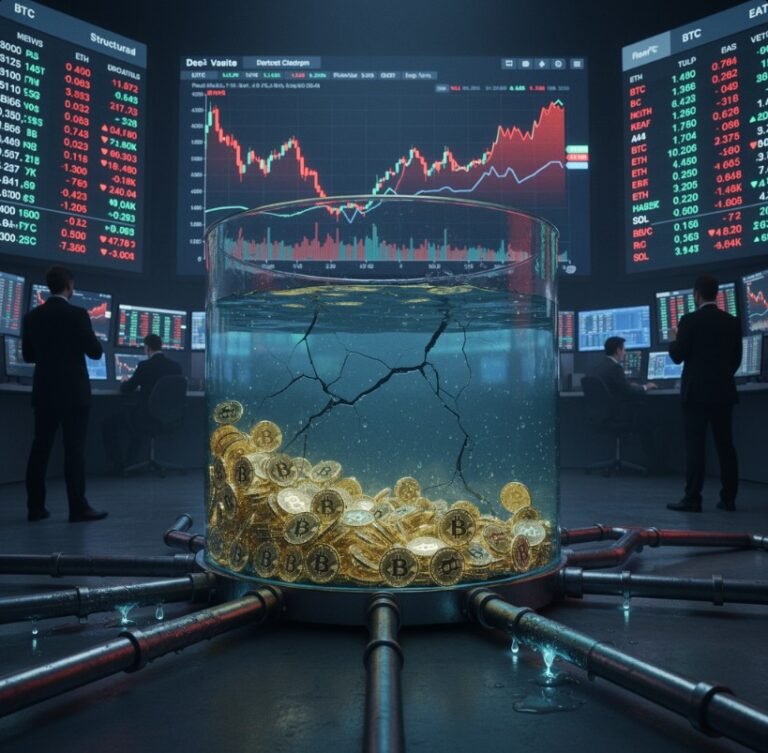
One of the most closely watched Bitcoin on-chain signals is exchange reserve data. When more Bitcoin sits on centralized exchanges, traders often interpret it as potential sell-side liquidity. When reserves fall, the available liquid supply can shrink.
Coin Metrics reported in late April 2026 that Bitcoin exchange reserves had reached a seven-year low of about 2.3 million BTC. The same report noted that the Coinbase premium had moved into positive territory, suggesting stronger U.S. spot demand relative to offshore markets.
This matters because war-driven macro volatility can make thin markets more reactive. If fewer coins are available on exchanges, even moderate shifts in demand can produce sharper price moves. However, low exchange reserves do not guarantee rising prices. They only show that fewer holders are keeping coins immediately available for sale.
Therefore, the signal must be read carefully. Long-term storage can reflect conviction, but it can also reflect delayed selling. In uncertain periods, investors may avoid exchanges until price levels or liquidity conditions become more attractive.
Still, the reserve decline is important. It suggests that Bitcoin’s market structure is becoming more supply-sensitive at a time when global investors are already adjusting to oil shocks, inflation pressure, and foreign-policy risk.
Bitcoin’s Safe-Haven Debate Remains Unsettled
The US-Iran war has renewed discussion about Bitcoin’s role during geopolitical crises. Some investors see Bitcoin as a hedge against currency debasement and financial censorship. Others view it as a volatile asset that falls when liquidity tightens.
Recent price behavior supports both interpretations. Investing.com reported on April 30, 2026, that Bitcoin was trading near $76,500 after slipping below $76,000 amid renewed Iran conflict fears and a hawkish Federal Reserve outlook. The same report noted that major altcoins also weakened, showing broader caution across crypto assets.
This reaction shows that Bitcoin is not insulated from macro stress. When traders fear higher energy prices, persistent inflation, or tighter monetary policy, they often reduce exposure to volatile assets. Bitcoin can suffer during those episodes.
However, Bitcoin on-chain signals also show that long-term holders are not behaving like short-term speculators. Falling exchange reserves suggest that many holders are not rushing to sell into every geopolitical shock. As a result, Bitcoin’s identity remains mixed. It is not yet a pure safe haven like gold, but it is no longer just a high-beta technology trade.
Stablecoins Are the Crisis Liquidity Layer
Another important part of the on-chain story is stablecoin movement. During geopolitical stress, stablecoins often serve as the cash layer of crypto markets. They allow traders to move quickly between exchanges, hold dollar exposure, and manage settlement risk without relying entirely on traditional banking rails.
Stablecoin use has continued to grow. Forbes reported that stablecoin transfer volume reached a record $4.5 trillion in the first quarter of 2026, citing an a16z report and noting that Asia accounted for nearly two-thirds of flows.
This is significant for Bitcoin because stablecoin liquidity often determines how quickly traders can buy or sell during volatile events. When stablecoin balances move onto exchanges, it can suggest buying power. When they leave exchanges, it can indicate caution, settlement demand, or a shift toward off-exchange storage.
However, analysts must separate real economic use from mechanical transaction volume. A 2026 Boston Consulting Group report noted that stablecoin on-chain transaction volumes are heavily affected by bots and internal transactions. The report also found that investment and trading dominate adjusted stablecoin volumes.
Therefore, stablecoin data should not be read as a simple adoption story. It is better understood as a liquidity map. In the current crisis, that map helps explain how capital moves when banks, exchanges, and cross-border payment systems face stress.
On-Chain Sanctions Risk Is Rising
The war has also intensified regulatory scrutiny of crypto flows. Chainalysis reported in April 2026 that the U.S. Office of Foreign Assets Control updated its Central Bank of Iran designation following a record $344 million Tether seizure linked to controversy around Strait of Hormuz tolls.
This development shows why on-chain intelligence is no longer only a trading tool. It has become part of sanctions enforcement, compliance monitoring, and national-security analysis.
For exchanges, this creates operational pressure. Platforms must improve screening tools, monitor high-risk wallets, and respond quickly when authorities identify sanctioned entities. For stablecoin issuers, it raises difficult questions about freezing powers, jurisdiction, and user confidence.
For Bitcoin users, the issue is more complex. Bitcoin itself does not have a centralized issuer that can freeze balances. However, users still rely heavily on exchanges, custodians, and payment processors. As a result, sanctions risk can influence market liquidity even when the base protocol remains neutral.
In this environment, Bitcoin on-chain signals help regulators and market participants understand whether capital is moving through transparent, compliant channels or shifting toward higher-risk pathways.
Miners Face Energy-Market Pressure
The energy shock also affects Bitcoin mining. Higher fuel prices and power-market volatility can pressure miners, especially those operating in regions where electricity prices are tied to natural gas or oil-linked markets.
Mining-related on-chain data can reveal stress before it appears in earnings reports. Analysts watch miner wallet balances, exchange transfers, and hash-rate trends to assess whether miners are selling coins to cover costs.
If energy prices remain elevated, some miners may reduce operations, delay expansion, or sell more Bitcoin. That could add supply to the market. However, stronger miners with fixed power contracts or access to cheaper energy may gain market share.
This is one reason the current crisis matters beyond daily price movement. It may reshape the economics of Bitcoin production. Over time, that could influence hash-rate concentration, miner balance sheets, and the geographic distribution of mining activity.
Institutions Are Reading the Chain More Carefully
Institutional investors increasingly use Bitcoin on-chain signals alongside macro indicators. In earlier cycles, many funds focused mainly on price momentum, futures basis, and exchange volume. Now, they also track exchange reserves, realized capitalization, wallet age bands, stablecoin flows, and long-term holder behavior.
This shift reflects the maturation of the market. Bitcoin is now connected to exchange-traded products, custodians, payment firms, and macro portfolios. Therefore, its on-chain behavior can influence broader allocation decisions.
The current crisis has accelerated that process. When oil markets move sharply and central banks delay easing, institutions need faster data. Traditional reports often arrive with a lag. On-chain data, by contrast, updates continuously.
Still, the data has limits. Wallet labels can be imperfect. Exchange flows may reflect internal rebalancing rather than customer activity. Large wallets may represent custodians rather than single investors. For this reason, serious analysis requires caution, context, and multiple signals.
Retail Investors Face a More Complex Market
For retail investors, the rise of on-chain analysis can be useful but also confusing. Many online commentators present individual metrics as clear buy or sell signals. In reality, Bitcoin on-chain signals are probabilistic, not predictive.
Low exchange reserves may support a bullish supply argument. Yet if macro liquidity tightens, demand can still fall. Rising stablecoin supply may suggest available buying power. Yet those funds may remain idle. Miner selling may create pressure. Yet it may also mark the end of forced supply.
Therefore, retail investors should avoid treating any single metric as conclusive. The better approach is to compare on-chain data with market structure, macro conditions, and risk tolerance.
In the current environment, that means watching energy prices, central bank decisions, exchange liquidity, and geopolitical headlines alongside blockchain data. Bitcoin’s public ledger provides useful evidence, but it does not remove uncertainty.
Industry Response Is Becoming More Professional
The industry response to war-driven volatility has been more disciplined than in previous cycles. Exchanges have improved proof-of-reserves reporting. Analytics firms provide more detailed wallet clustering. Custodians offer institutional clients better risk dashboards. Meanwhile, stablecoin issuers face growing expectations around transparency and compliance.
These changes do not eliminate risk. However, they make the market more observable. That visibility is important during geopolitical crises because it allows investors to distinguish between panic narratives and measurable flows.
For example, a sudden price decline may look like broad capitulation. But if on-chain data shows limited long-term holder selling and stable exchange reserves, the interpretation may be different. Conversely, a price rally may appear strong, but weak spot inflows and heavy leverage may suggest fragility.
This is where Bitcoin on-chain signals provide real value. They do not predict the future with certainty. Instead, they help explain the present more clearly.
A Market Defined by Liquidity, Not Certainty
The US-Iran war has reminded investors that crypto markets are deeply connected to global liquidity. Oil shocks affect inflation expectations. Inflation expectations shape central-bank policy. Central-bank policy influences risk appetite. Risk appetite then flows through Bitcoin, stablecoins, and altcoins.
On-chain data makes these connections more visible. Exchange reserves show available supply. Stablecoin flows show settlement behavior. Miner wallets show production pressure. Long-term holder data shows conviction or fatigue.
The conclusion is not that Bitcoin has become a perfect hedge. It has not. Nor is the conclusion that Bitcoin is simply another speculative asset. The data suggests something more nuanced.
Bitcoin is becoming a macro asset with a transparent settlement layer. Its price still reacts to fear, liquidity, and policy. Yet its on-chain structure shows that many holders continue to treat it as a long-term reserve, even during geopolitical stress.
As the conflict continues to reshape energy markets and monetary expectations, Bitcoin on-chain signals will remain essential. They offer a real-time view of market behavior at a moment when traditional indicators are struggling to keep pace.
About the Author