

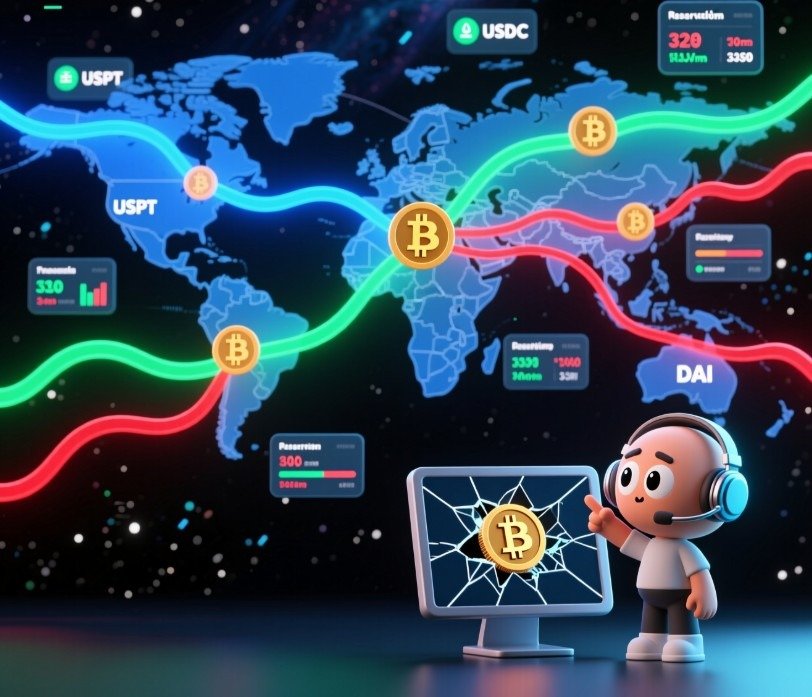
Stablecoin on-chain flows are emerging as one of the clearest indicators of how digital-dollar liquidity moves during global stress. As the US-Iran war disrupts energy markets, raises inflation risks, and forces central banks to reassess policy, stablecoins are no longer just a trading instrument inside crypto exchanges. They are becoming a real-time map of payment demand, liquidity management, sanctions exposure, and dollar access.
The broader macro backdrop is severe. Reuters reported on April 30, 2026, that analysts had lifted oil forecasts because the Iran war and Strait of Hormuz disruption were expected to keep energy markets tight. Brent crude had moved above $120 per barrel, and expectations for 2026 shifted toward a supply deficit.
That matters for stablecoins because oil shocks travel quickly through emerging markets, import costs, foreign-exchange demand, and household purchasing power. When local currencies face pressure or banking channels become more expensive, dollar-linked digital assets often attract attention.
However, the story is not simple. Stablecoins can support faster payments and liquidity access. They can also raise questions about compliance, consumer protection, market concentration, and financial sovereignty.
Digital Dollars Move Faster Than Traditional Settlement
The main reason stablecoin on-chain flows matter is speed. Traditional cross-border payments often pass through several intermediaries. Settlement can take days, especially when correspondent banking channels are limited or compliance reviews slow down transfers.
Stablecoins operate differently. On public blockchains, users can move tokenized dollars around the clock. Transactions settle according to network rules rather than bank operating hours. This makes stablecoins attractive during periods of volatility.
For traders, stablecoins provide dry powder. For businesses, they can support faster settlement. For households in inflation-sensitive regions, they may offer temporary dollar exposure. For institutions, they can function as a bridge between crypto markets and cash management.
This utility has helped stablecoin activity expand. Forbes reported that stablecoin transfer volume reached a record $4.5 trillion in the first quarter of 2026, citing an a16z report and noting that Asia accounted for nearly two-thirds of flows.
Yet headline volume needs careful interpretation. A large number does not automatically mean everyday payment adoption is widespread. It may reflect exchange activity, market making, automated transfers, and internal wallet movements.
Not All Stablecoin Volume Is Economic Activity
The stablecoin market has a measurement problem. Public blockchains show transactions, but they do not always show intent. A transfer can represent a real payment, an exchange rebalance, a trading strategy, a bot loop, or a bridge transaction.
Boston Consulting Group highlighted this issue in a 2026 report, noting that stablecoin on-chain transaction volumes are dominated by bots and internal transactions. The same report found that investment and trade dominate adjusted stablecoin volumes.
This does not make stablecoin data useless. Instead, it means analysts must separate raw volume from adjusted volume. They must also compare wallet behavior, exchange flows, transaction size, chain selection, and geographic indicators.
During a crisis, these distinctions are critical. A spike in stablecoin activity may signal demand for digital dollars. It may also signal arbitrage, exchange stress, or traders repositioning after a price shock.
Therefore, stablecoin on-chain flows should be read as market intelligence, not as a simple adoption score.
War Risk Changes the Geography of Liquidity
The US-Iran war has placed the Strait of Hormuz at the center of global market attention. Because the waterway is linked to major energy shipments, disruption affects oil prices, shipping costs, insurance premiums, and inflation expectations.
The Guardian reported on April 29, 2026, that U.S. gas prices had reached $4.23 per gallon, the highest level since 2022, as Hormuz fears drove oil higher. The report also noted that Brent crude had climbed sharply since mid-April.
When energy prices rise, dollar demand can increase in countries that import fuel. Businesses need dollars for trade finance. Consumers face higher prices. Governments may defend currencies or subsidize energy. In that environment, stablecoins can become an alternative route for dollar liquidity.
This does not mean stablecoins replace banks. Most large trade payments still rely on regulated financial institutions. However, stablecoins can fill gaps where speed, access, or cost becomes a problem.
That is why stablecoin on-chain flows are useful. They show where digital-dollar liquidity is moving before official statistics capture the full impact.
Exchanges Remain the Main Stablecoin Hubs
Despite growing payment use cases, exchanges remain central to stablecoin activity. Many users acquire stablecoins on centralized platforms. Traders move them between venues. Market makers use them to settle positions. Institutions use them to manage collateral.
This creates a concentration risk. If a major exchange faces liquidity pressure, regulatory action, or operational disruption, stablecoin flows can shift quickly. Large inflows may suggest users preparing to trade. Large outflows may suggest caution, self-custody, or institutional settlement.
During geopolitical stress, exchange flows are especially important. Investors often reduce exposure to volatile tokens and increase stablecoin balances. However, when confidence improves, those stablecoins can rotate back into Bitcoin, Ethereum, or other assets.
This makes stablecoins a liquidity reservoir. They do not only reflect current fear. They also represent potential future buying power.
Still, the reservoir can move in either direction. If the macro environment worsens, stablecoin holders may exit to banks or Treasury-linked products. If conditions stabilize, they may redeploy into crypto assets.
Sanctions Pressure Is Reshaping Stablecoin Policy
The war has also made sanctions compliance a central issue. Chainalysis reported in April 2026 that OFAC updated its Central Bank of Iran designation after a record $344 million Tether seizure tied to controversy around Strait of Hormuz tolls.
This event illustrates the dual nature of stablecoins. On one hand, they can make payments faster and more transparent. On the other hand, they can move across borders in ways that attract national-security scrutiny.
Stablecoin issuers operate in a difficult position. They must maintain user confidence while complying with law enforcement requests and sanctions rules. That often means freezing addresses linked to illicit finance or sanctioned entities.
For compliant institutions, this can be positive. It shows that stablecoin systems can work within regulatory frameworks. For users who value censorship resistance, it raises concerns about centralized control.
The result is a growing divide between regulated stablecoin infrastructure and more permissionless crypto networks. In the coming years, this divide may shape where liquidity concentrates.
Emerging Markets Are Watching Closely
Stablecoin on-chain flows are especially relevant in emerging markets. In countries with inflation pressure, capital controls, weak banking access, or expensive remittances, digital dollars can be attractive.
The current energy shock may intensify that demand. Higher oil prices often weaken current-account balances in importing countries. They can also increase food and transport costs. As households and businesses search for dollar exposure, stablecoins may see more use.
However, stablecoins also create policy concerns. If residents shift savings into digital dollars, local authorities may worry about currency substitution. Banks may lose deposits. Regulators may impose stricter controls on exchanges and payment apps.
Therefore, adoption will not be uniform. Some jurisdictions may welcome stablecoins as payment innovation. Others may restrict them to protect monetary control. The on-chain data will show where users continue to find access despite regulatory friction.
Institutions Want Cleaner Data
Institutional investors and payment companies are no longer satisfied with raw blockchain dashboards. They want cleaner data that distinguishes real settlement from noise. This demand is changing the analytics market.
Firms now focus on adjusted transaction volume, active addresses, exchange-tagged flows, wallet cohorts, chain-level settlement patterns, and stablecoin velocity. These metrics help institutions understand whether stablecoins are being used for trading, savings, remittances, or commercial payments.
This is especially important during geopolitical crises. A bank, asset manager, or payment company cannot rely on viral charts. It needs defensible analysis. It must know whether flows are compliant, concentrated, organic, or related to high-risk entities.
As a result, stablecoin on-chain flows are becoming part of institutional risk management. They are not just crypto-native indicators. They are now relevant to treasury teams, compliance departments, macro strategists, and regulators.
Payment Firms See Opportunity and Risk
Payment companies are also studying stablecoins more seriously. The appeal is clear. Stablecoins can reduce settlement delays, support programmable payments, and operate across borders. They may also help businesses manage working capital more efficiently.
However, risks remain. Stablecoin payments depend on wallet security, blockchain fees, issuer solvency, regulatory treatment, and user experience. A payment rail is only useful if customers trust it and merchants can convert it reliably.
The crisis has sharpened this debate. When traditional costs rise, stablecoins look more attractive. But when sanctions risk rises, compliance becomes harder. Payment firms must balance innovation with legal responsibility.
The likely outcome is not a single global stablecoin system. Instead, the market may split into regulated institutional rails, retail wallet ecosystems, exchange-based liquidity networks, and region-specific payment corridors.
On-chain data will be the evidence layer connecting these systems.
Bitcoin and Stablecoins Are Becoming Interdependent
Bitcoin often receives the most attention during geopolitical stress, but stablecoins increasingly determine how crypto markets function. Bitcoin may serve as the headline asset. Stablecoins provide the liquidity layer beneath it.
When traders sell Bitcoin, they often move into stablecoins. When they reenter the market, stablecoins become the funding source. When exchanges face volatility, stablecoin balances help absorb shocks. When institutions adjust collateral, stablecoins often serve as settlement units.
This interdependence means that Bitcoin analysis is incomplete without stablecoin analysis. A decline in Bitcoin exchange reserves may suggest long-term holding, but stablecoin inflows can show whether buyers are preparing to step in. A Bitcoin rally may look strong, but weak stablecoin support may reveal limited liquidity.
Therefore, stablecoin on-chain flows are no longer secondary indicators. They are part of the core market structure.
Regulators Are Moving From Theory to Evidence
For regulators, stablecoin data offers both a challenge and an opportunity. The challenge is scale. Public blockchains generate enormous transaction volumes, and not all of them are meaningful. The opportunity is transparency. Unlike many traditional financial flows, stablecoin transactions can be traced across public ledgers.
This transparency can support sanctions enforcement, anti-money-laundering work, and systemic-risk monitoring. However, it can also create privacy concerns. Users may not want every transaction to be visible, even if they are acting lawfully.
The policy debate will likely focus on how to preserve useful transparency while protecting legitimate privacy and preventing illicit finance. That debate will grow more urgent if stablecoin flows continue expanding during crises.
The New Map of Dollar Demand
The most important lesson from the current crisis is that stablecoins reveal dollar demand in real time. Traditional data often arrives monthly or quarterly. Stablecoin on-chain flows update constantly.
That does not make them perfect. They can be noisy, distorted, and difficult to interpret. But they are increasingly valuable because they show how users react before official statistics are published.
In the US-Iran war environment, this matters. Energy shocks, sanctions, inflation concerns, and monetary uncertainty all affect demand for dollars. Stablecoins are one of the fastest ways to observe that demand in digital markets.
The industry response will determine whether stablecoins become trusted infrastructure or remain mostly trading tools. Better transparency, stronger compliance, clearer regulation, and improved user protection will be essential.
For now, the message from the chain is clear. Stablecoins are no longer peripheral to crypto markets. They are the settlement layer, the liquidity buffer, and the crisis map for digital dollars.
About the Author