

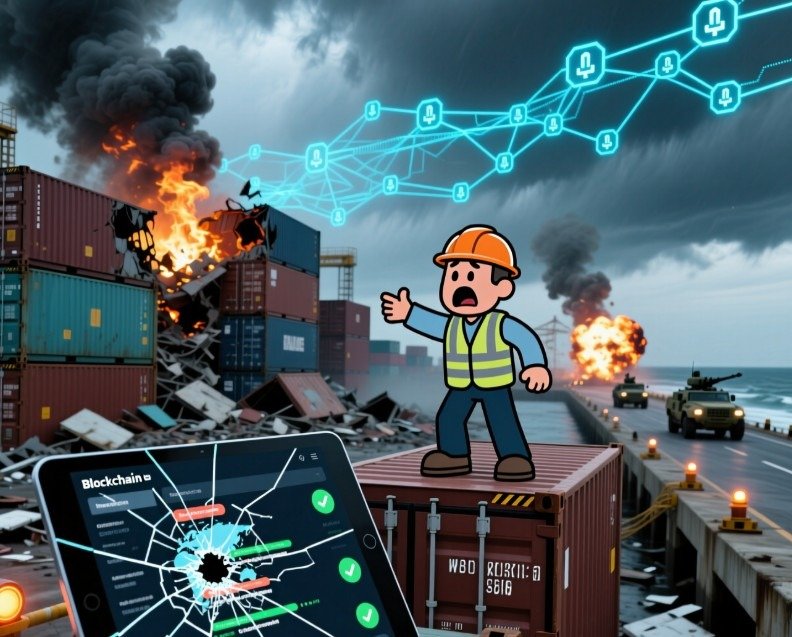
Blockchain Settlement Rails Enter a More Serious Phase
Blockchain Settlement Rails are becoming part of a larger debate about payments, sanctions, liquidity, and financial resilience. The U.S.-Iran war has pushed that debate forward. As oil markets react and shipping routes face disruption, banks and companies are rethinking how money moves across borders.
In earlier crypto cycles, blockchain payments were often described as faster alternatives to banking systems. That argument still matters. However, speed is no longer the only issue. In a conflict environment, payment systems also need trust, compliance, and clear oversight.
Reuters reported on April 29, 2026, that shipping through the Strait of Hormuz had slowed sharply during the U.S.-Iran deadlock. The Guardian also reported that U.S. gasoline prices had climbed as concerns over Hormuz pushed oil prices higher.
For crypto markets, the question is difficult. Can blockchain-based settlement provide resilience during stress? Or does it create new risks around sanctions evasion, liquidity pressure, and regulatory scrutiny?
Speed Is No Longer Enough
The original case for blockchain settlement was simple. Traditional cross-border payments can be slow. They may pass through several banks. They can be delayed by time zones, manual checks, and high fees. Blockchain networks can settle transfers faster, often within minutes.
Stablecoins made this argument stronger. They allow users to move dollar-linked value across blockchain networks. They also operate outside normal banking hours. For exchanges, stablecoins provide liquidity. For companies, they may reduce settlement delays.
However, a wartime environment changes the discussion. A payment network must do more than move quickly. It must show that funds are not passing through sanctioned entities. It must help identify counterparties when required. It must also protect legitimate privacy.
This creates a difficult balance. Public blockchains are transparent, but users can create many addresses. Permissioned blockchains offer stronger identity controls, but they reduce openness. Stablecoins are efficient, but regulators worry about illicit finance.
As a result, blockchain settlement is no longer just a technology story. It is now a policy story.
Stablecoins Face a Compliance Test
Stablecoins are among the most important tools in blockchain settlement. They are widely used in crypto trading. They are also becoming more relevant for cross-border payments, treasury management, and digital commerce.
Their appeal is clear. A business can send value quickly. An exchange can manage liquidity. A user in an unstable economy can access a dollar-linked asset. These features help explain why stablecoins have become central to crypto markets.
Yet the same features create concern. A token that moves quickly across borders can support legitimate commerce. It can also be misused by sanctioned actors, shell companies, or intermediaries trying to avoid restrictions.
During a conflict involving Iran, this issue becomes more sensitive. Stablecoin issuers and exchanges face pressure to monitor wallets, freeze prohibited addresses when legally required, and strengthen know-your-customer systems. Blockchain analytics firms also play a larger role because they help detect suspicious flows.
This creates tension inside crypto. Some users believe too much control weakens decentralization. Regulators argue that payment systems cannot ignore sanctions, money laundering, or terrorism financing risks. Institutions usually prefer stronger compliance because legal uncertainty can keep capital away.
Exchanges Become Front-Line Gatekeepers
Crypto exchanges are now major gateways between blockchain networks and the traditional financial system. During a geopolitical crisis, this role becomes more important.
If sanctioned entities try to use crypto markets, exchanges are expected to detect them. If volatility rises, exchanges must manage liquidity and leverage. If users move funds quickly across borders, compliance teams must decide whether the activity is normal or risky.
This responsibility has grown because crypto is more connected to mainstream finance. Spot Bitcoin funds, institutional custody, tokenized Treasury products, and corporate stablecoin use have narrowed the gap between crypto and traditional markets.
Therefore, a failure inside crypto can have wider effects. A compliance failure can attract regulators. A liquidity failure can damage market confidence. A cybersecurity failure can expose customers and institutions.
Large exchanges have responded by building stronger monitoring systems. They screen transactions, review sanctions exposure, and cooperate with law enforcement when required. Even so, the pressure is likely to increase as the war continues to affect markets.
Tokenized Finance Gains Attention
The crisis has also increased interest in tokenized finance. Tokenized Treasury bills, tokenized deposits, money market funds, and trade finance products are designed to bring traditional assets onto blockchain rails.
These products are different from speculative tokens. They are built around regulated assets and institutional use cases. For banks and asset managers, that difference matters.
Tokenized finance can offer faster settlement. It can make ownership records clearer. It can allow collateral to move more efficiently. It can also support better audits if regulators receive appropriate access.
However, tokenization does not remove macroeconomic risk. If oil prices rise, inflation pressure can increase. If shipping delays continue, companies may face higher costs. If sanctions expand, cross-border payments may become harder.
Tokenization improves the financial plumbing. It does not change the underlying economy. This distinction is important for investors and policymakers.
Bitcoin’s Role Remains Unclear
Bitcoin often becomes part of public debate during geopolitical shocks. Some investors see it as a hedge against monetary instability. Others see it as a risk asset that depends on market liquidity.
Recent market behavior has supported both views at different times. Morningstar noted that Bitcoin had risen since the start of the Iran conflict, while also warning that crypto correlations with equities can change during stress.
For blockchain settlement, Bitcoin is not the main corporate payment tool. Its volatility makes it difficult to use for routine settlement. Companies generally need a stable unit of account. That is why stablecoins, tokenized deposits, and permissioned networks are more relevant for business payments.
Still, Bitcoin influences market psychology. When it rises during geopolitical stress, supporters argue that decentralized assets are proving their value. When it falls, critics argue that crypto remains tied to liquidity and risk appetite.
The more practical story is quieter. It is about payment infrastructure, compliance, and settlement efficiency.
Risks Are Growing
Blockchain settlement systems face several risks in the current environment. The first is regulatory escalation. If governments believe digital assets are being used to bypass sanctions, they may impose stricter rules on exchanges, stablecoin issuers, wallet providers, and decentralized finance protocols.
The second risk is liquidity concentration. In periods of stress, users may move from smaller tokens into stablecoins or from smaller exchanges into larger platforms. If liquidity becomes concentrated in a few firms, the market may depend too heavily on those firms’ risk controls.
The third risk is cybersecurity. War can increase cyber threats. Exchanges, wallets, bridges, and custodians may become targets. Blockchain transactions may be final, but the systems around them can still fail.
The fourth risk is legal uncertainty. A blockchain transaction may settle technically, but ownership rights and dispute resolution may still depend on courts and contracts. Institutions need legal clarity before they rely heavily on blockchain settlement.
Finally, there is reputational risk. If blockchain rails are linked to sanctions evasion, the industry may lose political support. If they are linked to transparent and compliant settlement, they may gain legitimacy.
A Hybrid Payment System Is More Likely
The most realistic future is not a fully decentralized payment system replacing banks. A hybrid model is more likely.
Public blockchains may continue to support open markets. Permissioned networks may serve banks and institutions. Stablecoins may remain important for liquidity. Tokenized deposits may grow inside regulated banking systems. Central banks may continue to test digital settlement tools.
This model is less dramatic than some early crypto visions. However, it may be more durable. It allows blockchain technology to improve settlement without ignoring regulation.
The U.S.-Iran war has made payment weaknesses more visible. Sanctions, oil shocks, shipping delays, and market volatility all increase demand for faster and more reliable settlement. Blockchain Settlement Rails may benefit from that demand, but only if they meet higher standards.
The question is no longer whether blockchain can move money quickly. It can. The real question is whether it can move money responsibly during a crisis.
That answer will shape the next phase of blockchain finance.
About the Author