
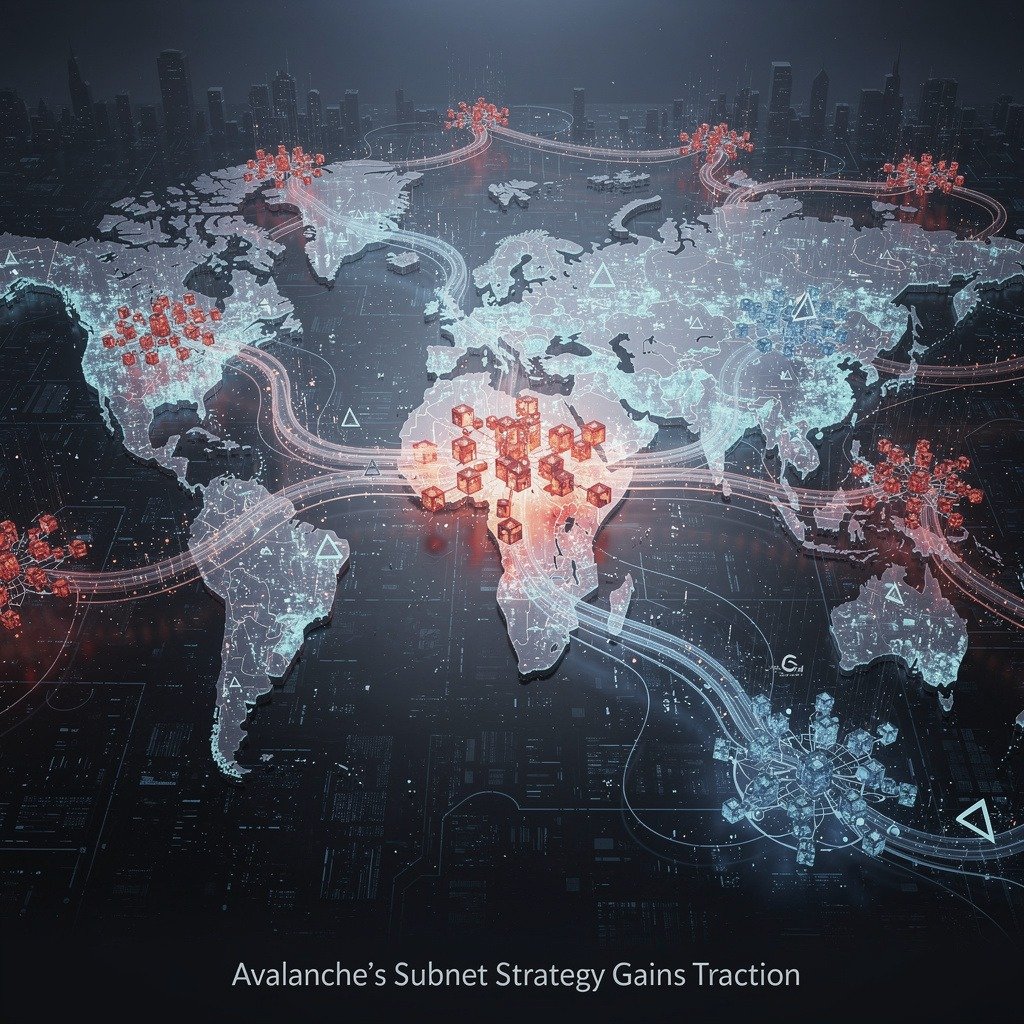
Avalanche has long distinguished itself with a unique architectural model centered around subnetworks—independent blockchains that run in parallel under the broader Avalanche ecosystem. For years, this approach was considered experimental, overshadowed by the explosive growth of other ecosystems. But in recent months, Avalanche’s strategy has begun paying off as enterprises, game studios, and financial institutions explore subnets as a fast, customizable, and compliant infrastructure layer.
Avalanche’s narrative has evolved significantly since its early days as a high-speed, high-throughput layer-1 network. While its consensus mechanism and transaction speed remain competitive, it is the subnet model that has captured the attention of developers and institutional partners. Subnets enable projects to deploy dedicated chains with tailored rules, gas fee models, virtual machines, and permission structures—something no other major network currently offers at scale.
One of the most high-profile developments is the adoption of Avalanche subnets by financial firms exploring tokenization, compliance-focused digital asset environments, and high-frequency settlement systems. These institutions require isolated execution environments where they can control validators, enforce regulatory rules, and maintain performance predictability. Avalanche’s subnets provide exactly that: customizable blockchains backed by a broader decentralized network.
The gaming industry has also embraced this model. Several studios have launched subnets to support high-throughput gaming economies, real-time asset transfers, and in-game marketplaces. Unlike traditional blockchain gaming, where congestion and high fees can disrupt user experience, Avalanche subnets allow game developers to create gasless or near-gasless environments optimized for player activity.
Avalanche’s bridging infrastructure and EVM compatibility further boost adoption. Developers familiar with Ethereum tooling can launch subnets without learning new programming paradigms, reducing friction and accelerating deployment cycles. Meanwhile, Avalanche’s main network continues to provide a settlement layer with strong security and decentralization.
However, Avalanche faces several challenges on its path to broader adoption. The subnet model, while powerful, requires more technical sophistication than standard smart contract deployment. Additionally, competition from modular ecosystems like Ethereum rollups and Cosmos app-chains remains strong. These rival architectures offer alternative solutions for customization and scalability, forcing Avalanche to differentiate itself through performance, developer experience, and enterprise support.
Despite competitive pressures, Avalanche’s institutional momentum is growing. If the subnet model continues to gain traction, the network could become a foundational platform for custom-built blockchains powering finance, gaming, and large-scale applications.
About the Author