
For much of Bitcoin’s history, mining has been misunderstood—portrayed alternately as an environmental villain, a race for industrial dominance, or an obscure technical process accessible only to specialists. Yet heading into 2025, the mining industry stands on the brink of its most significant transformation since ASICs revolutionized the sector nearly a decade ago. A convergence of technological breakthroughs, geopolitical realignments, energy-market disruption, and AI-driven optimization is redefining Bitcoin mining from a competitive arms race into a sophisticated global energy industry.
The shift began slowly. As Bitcoin’s price entered new institutional territory and mining rewards halved once again, many predicted a wave of miner capitulation that would leave the network vulnerable. Instead, miners adapted. Efficiency climbed. Energy sources diversified. AI-driven analytics entered the field. Renewable penetration surged. And the narrative around mining began to change—not as a drain on the grid, but as a flexible load capable of supporting, stabilizing, and monetizing energy generation worldwide.
Now, a remarkable new story is unfolding: Bitcoin mining is evolving into a global infrastructure layer for the future of energy.
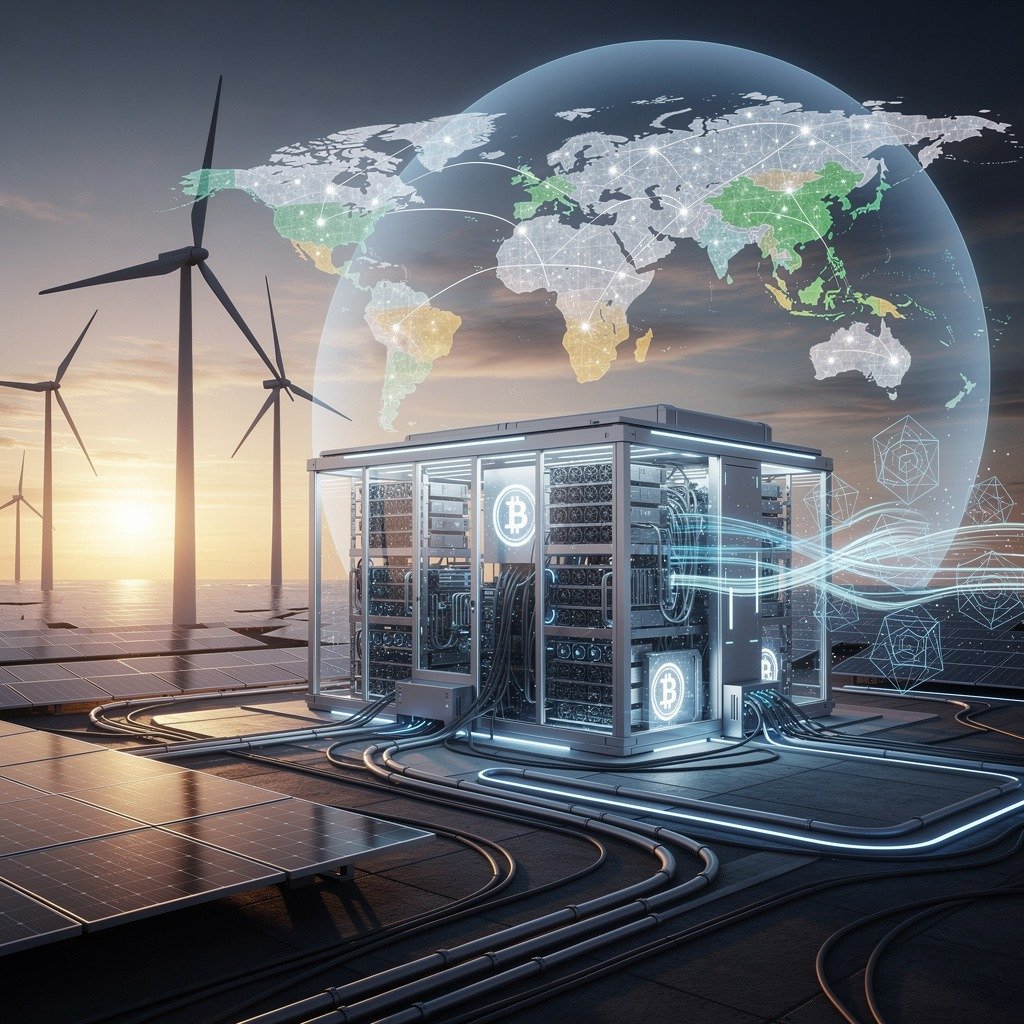
The most dramatic change is occurring in the energy markets themselves. Across North America, the Middle East, Latin America, and parts of Africa, power producers are partnering with Bitcoin miners as a way to monetize excess capacity. Renewable power sources—particularly wind, solar, and hydro—are notoriously inconsistent. They generate energy when nature provides it, not when markets demand it. This mismatch leads to enormous inefficiencies: curtailment, wasted power, and financially unstable renewable facilities.
Bitcoin miners are filling that gap. They consume energy instantly, can be turned on or off within seconds, and require no long-term delivery guarantees. This makes them a perfect “energy sponge” that absorbs excess generation and increases profitability for renewable providers. In Texas, miners have become integral to grid-balancing operations, voluntarily shutting down during peak demand and even sending power back to the grid. The same trend is emerging in Canada, Iceland, Paraguay, Oman, and several African nations where renewable overproduction creates both risk and opportunity.
At the same time, growing interest in methane mitigation has propelled mining into a surprising role within the environmental sector. Flaring from oil fields—long a source of greenhouse emissions—can now be captured and converted into electricity to mine Bitcoin. Unlike traditional mitigation technologies, mining monetizes the captured methane, turning a climate liability into financial incentive. Companies specializing in flare-gas mining have expanded rapidly, forging partnerships with energy producers seeking compliance-friendly ways to reduce emissions. Research indicates that using flare gas for mining is not only cleaner than venting but also cleaner than flaring because the methane is combusted more efficiently.
While energy integration expands globally, Bitcoin miners are harnessing a powerful new tool: artificial intelligence. What was once a largely hardware-dominated industry is rapidly becoming a software-driven one. AI-powered monitoring systems now optimize hashrate allocation, predict hardware degradation, manage cooling efficiency, and even adjust workloads based on dynamic energy pricing. Entire mining facilities are operated through predictive AI models that determine, hour by hour, whether mining or load shedding is more profitable. This marks a significant evolution—mining is no longer merely about brute-force computational power but about intelligent energy and resource management.
The industry is also shifting geographically. After China’s mining ban in 2021, the United States became the dominant mining hub, but new regions are emerging. Saudi Arabia, the UAE, Kazakhstan, Ethiopia, Brazil, and Argentina are all expanding their mining footprints. Some are building it directly into national energy strategies. Others are partnering with private data infrastructure companies that treat mining as one component of a broader digital energy stack. This dispersion strengthens Bitcoin’s decentralization and enhances network security by reducing dependence on any single jurisdiction.
Infrastructure advancements are also reshaping the physical footprint of mining. Immersion cooling technologies—where miners operate submerged in thermally conductive liquid—are enabling higher efficiency, quieter facilities, and greater hardware longevity. Immersion mining is becoming standard for large-scale industrial operations, particularly in hot climates where traditional air-cooled setups struggle. This new generation of mining facilities looks less like noisy server farms and more like advanced energy plants.
Meanwhile, Bitcoin’s economic foundation continues to shift as post-halving dynamics reshape miner strategy. With block rewards declining, miners are increasingly relying on transaction fees, layer-2 activity, and protocol-level innovations to sustain profitability. The emergence of Bitcoin-native assets—Ordinals, Runes, ARC tokens, layer-2 rollup inscriptions—has introduced new fee markets that strengthen miner incentives. Critics once warned that Bitcoin’s security model would collapse as rewards fell; instead, a diverse fee economy is emerging, creating a multi-layered revenue model that may ultimately prove more resilient than the original one.
But challenges remain on the horizon. Electricity shortages, regulatory uncertainty, and rising competition are creating pressure for miners with outdated hardware or inefficient facilities. Consolidation is underway. Companies with access to cheap power, advanced cooling, AI-driven operations, and modern ASIC fleets are thriving; others face bankruptcy or acquisition. This Darwinian cycle is not new to mining—the industry has experienced several waves of restructuring—but the stakes are higher than ever. As Bitcoin becomes a global asset, the reliability of miners becomes central to financial infrastructure, not just crypto culture.
Regulators, meanwhile, are beginning to treat mining like a critical energy industry. Some countries have implemented licensing schemes, environmental reporting requirements, or tax frameworks that classify mining alongside other industrial energy consumers. Other jurisdictions remain hostile, citing environmental or economic concerns. Yet the global trend is increasingly supportive. Policymakers are coming to view Bitcoin mining not as an isolated digital activity but as an industrial process with clear energy, economic, and technological benefits.
What emerges from this global mosaic is a very different picture from the one painted by earlier Bitcoin critics. Mining is no longer a fringe competition between hobbyists and industrial farms. It is becoming a cornerstone of next-generation energy infrastructure, AI-driven optimization, and grid modernization. It supports renewable growth, stabilizes power markets, reduces methane emissions, and accelerates innovation in cooling and data center management.
For Bitcoin itself, the implications are profound. A stronger, more distributed mining ecosystem means greater network security. As miners diversify across geographies and energy sources, Bitcoin’s resilience grows. And as mining becomes deeply integrated into global energy systems, it becomes harder for political or economic actors to oppose the asset without disrupting their own power infrastructure.
Fifteen years ago, Bitcoin mining was a curiosity—an experiment conducted on laptops and desktop computers. Today, it stands at the intersection of AI, energy economics, industrial policy, and environmental engineering. The world’s most decentralized monetary network is secured not by abstract ideology but by a global coalition of energy producers, data scientists, and infrastructure operators who increasingly view Bitcoin not just as an asset, but as a critical tool for the future of clean, efficient, modern energy systems.
Bitcoin mining has been reborn. And its evolution is reshaping the future of not only digital finance, but global power itself.
About the Author